
The monsoon session of Parliament will set the tone for how the Hindu community feels about what happened at the Ram Mandir. Whether emotions will be stirred within the voters of India lies solely at the oratory skills of the Congressis and Samajwadis, notes Zainab Sikander.

The Samajwadi Party announced on Saturday that it would walk out of the opposition Maha Vikas Aghadi after Shiv Sena-Uddhav Balasaheb Thackeray chief Uddhav Thackeray's close aide hailed the demolition of Babri mosque and a related newspaper advertisement.

'We were expecting at least they would be held guilty, but instead they have gone scot-free'

Governor C V Ananda Bose, meanwhile, urged citizens not to be swayed by "provocative statements and rumours" and asked the state to ensure there was 'no disturbance anywhere'.

Union Home Minister Amit Shah addressed rallies in West Bengal, promising to address infiltration issues, resolve the Gorkha issue, and tackle corruption if the BJP wins the upcoming elections.

Assam Chief Minister Himanta Biswa Sarma has accused West Bengal's Mamata Banerjee government of diverting resources to 'Bangladeshi Muslim infiltrators' and warned of losing Bengal if she remains in power.

He also said that now everyone should listen to RSS chief Mohan Bhagwat's advice to shun habit of fighting on small disputes.
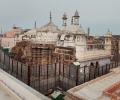
'Why were they silent when over 128 temples and shrines including Shivlings were broken down at the time of the construction of the Kashi Vishwanath corridor?' a Varanasi resident asks Rashme Sehgal.
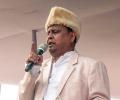
Suspended Trinamool Congress MLA Humayun Kabir asserts he will be a 'kingmaker' after the 2026 West Bengal assembly elections, claiming no government can be formed without his support. He plans to announce a new political party on December 22 and contest in 135 seats.

'Vijaya Raje Scindia had assured the prime minister that nothing would happen to the Babri Masjid'

A political controversy has erupted in West Bengal following the emergence of an alleged video purportedly showing Humayun Kabir claiming links with senior BJP leaders and efforts to defeat Chief Minister Mamata Banerjee in the upcoming Assembly elections.

Union Home Minister Amit Shah addressed poll rallies in West Bengal, promising to resolve the Gorkha issue constitutionally and offering a development package for north Bengal if the BJP is voted to power.

Courts cannot be the only hope for those fighting hate speech. Countering its effects on the ground takes more effort. With our political parties unwilling to put in that amount of effort, it's left to citizens to do so, points out Jyoti Punwani.
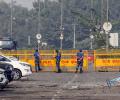
Officials reveal details of a foiled Jaish-e-Mohammed terror plot involving a doctor who planned a bomb blast near the Red Fort, timed around the Babri Masjid demolition anniversary. Arrests and investigations uncovered the interstate network.

Ayodhya Nagar Nigam corporator Haji Asad hoped that Kashi and Mathura issues will not be raked up after the CBI court ruling.

The Madhya Pradesh High Court referenced the Supreme Court's Ayodhya verdict principles while ruling on the Bhojshala-Kamal Maula mosque complex case, determining the site to be a temple dedicated to Goddess Saraswati.

Justice Agarwal retired from the high court on April 23, 2020.

The former CM said his party's Hindutva is "nationalism" and the Bharatiya Janata Party should explain what is its Hindutva.
The verdict by a special court in the Babri Masjid demolition case comes 28 years after kar sevaks razed the 16th century mosque and almost a year after the Supreme Court settled the land case in favour of a Ram temple at the disputed Ayodhya site.
The Trinamool Congress (TMC) has shared a purported video of Humayun Kabir, alleging a BJP conspiracy to influence the West Bengal elections. The video claims Kabir discussed strategies to divert minority votes and received funds for the plan. The BJP has denied the allegations, while Kabir claims the video is AI-generated and threatens legal action.

A court in Mumbai acquitted a 53-year-old man in a 1993 riots case, citing the prosecution's failure to prove his participation in the violence that followed the demolition of the Babri Masjid.

The invitation was delivered to him at his house located in Kotia Panjitola near the Ram Path,

A Muslim body fighting for rebuilding Babri Masjid in Ayodhya will not organise any protests on Saturday, on the anniversary of the demolition of the mosque, to express solidarity with the victims of the terrorist attacks in Mumbai.The All India Babri Masjid Re-building Committee said it will, instead, send a memorandum to President Pratibha Patil urging her to order the rebuilding of Babri Masjid at its original site in Ayodhya or refer all disputes related to the SC.
A political controversy has erupted in West Bengal following the emergence of an alleged video of Humayun Kabir, purportedly claiming links with senior BJP leaders and efforts to defeat Chief Minister Mamata Banerjee in the upcoming Assembly elections.

'People don't like leaders who just crib and complain without offering a clear objective.' 'Theoretically and pragmatically, Rahul has to show an agenda beyond bad-mouthing Mr Modi on economic policies, foreign policy...'

The deployment came on the day of the consecration of the new idol of Ram Lalla at the Ram temple in Ayodhya.

10 things you must know about the most famous foreign correspondent in India who made Bharat his home.
In an interview with rediff.com's Arun Lakshman, scholar, writer, teacher and social activist Professor Hameed Chendamangalur says that the people of the state have given a befitting reply to such organisations in the recently held local body polls.

The high-pitched campaign for the first phase of West Bengal assembly elections concluded with the BJP and TMC focusing on electoral rolls and dietary habits, while making promises to voters. Voting is scheduled in 152 constituencies across north Bengal and southern districts, with over 3.60 crore electors eligible to vote. A record number of Central paramilitary forces have been deployed, and several districts have been identified as highly sensitive.
Humayun Kabir, a former TMC minister, has been suspended from the party after announcing plans to lay the foundation of a "Babri Masjid-style" mosque on December 6. This move has sparked controversy and raised concerns about communal tensions in West Bengal.
The Liberhan Commission, inquiring into the 1992 Babri Masjid demolition, will reveal the names of those who had demolished the disputed structure at Ayodhya.
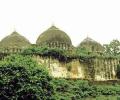
On October 5, 2019, the sessions court hearing the matter had said that as per Supreme Court orders, all evidence has to be presented before December 24, 2019, which would be the last working day.
'Mark had such a profound understanding of India, which was, of course, the land of his birth as well as of his death... He loved India, and lived two-thirds of his life here.'
Kalyan Singh, who was the Uttar Pradesh Chief Minister at the time of demolition of the Babri Masjid, on Tuesday suggested a negotiated settlement of the vexed Ram Janmbhomi-Babri Masjid tangle. Singh, who quit the BJP on Tuesday, said that when he was the chief minister, he had initiated steps to this effect but before a settlement could be reached, his government had to go.
The 17th anniversary of the demolition of the Babri Masjid largely remained a non-event in Ayodhya, in spite of the various programmes organised by political parties to mark the occasion. While the Vishwa Hindu Parishad observed it as 'Shaurya Diwas' (Valour Day) and the Babri Masjid Action Committee and the Samajwadi Party observed it as 'Black Day', the events held by them witnessed negligible participation by the locals.
Union Home Minister Amit Shah addressed poll rallies in West Bengal, promising to tackle corruption and illegal immigration if the BJP comes to power. He criticised the current TMC government and outlined the BJP's plans for the state.
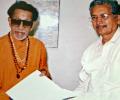
'In Independent India's politics you will not find any leader of a political party who has not contested elections or not held a powerful post.' 'It was only Balasaheb who never contested elections or held a post.' On the occasion of Balasaheb Thackeray's 99th birth anniversary, close aide Subhash Desai recalls vignettes about the Shiv Sena founder.
The government today extended the term of the Liberhan Commission probing the demolition of the Babri masjid in Ayodhya in 1992, till March 31 next year

Union Home Minister Amit Shah launched the BJP's manifesto for West Bengal, promising a Uniform Civil Code, a Bengali chief minister, and improved governance.

The alliance between Aam Janata Unnayan Party (AJUP) and AIMIM in West Bengal has collapsed following allegations of a multi-crore deal with the BJP, leading to AIMIM's withdrawal and both parties planning to contest the elections independently.
